With agroforestry as climate compensation
September 30, 2021
Forests will be crucial if countries and businesses are to achieve their net-zero climate impact goals. But if arable land is converted to tree plantations, it risks disrupting vital food production, not least for the most vulnerable. ZeroMission works with agroforestry projects that combine sustainable forestry with food production. With the right planting models, trees and smaller crops such as shrubs and plants can benefit from each other's characteristics, while increasing both carbon storage and yields of fruits and vegetables.
Agroforestry
Humanity faces a major challenge in combating climate change. At the same time, hunger is a huge problem that is expected to get worse as the climate changes and extreme weather events become more frequent. What is needed is a method that both ensures long-term carbon sequestration and protects the fragile production of food. Agroforestry is an umbrella term for different methods of co-planting that increase carbon storage and ensure food production. The method does not always have to involve only trees and plants, but herbs, fungi and even animals can also be part of different planting models. The key to the model lies in variety and co-planting. The last thing we want if we are to promote both food and carbon sequestration is one-sided monocultures where a single type of tree is planted. This has negative consequences for carbon sequestration, production, ecosystems and biodiversity. Learn more about the different types of carbon storage available on the market.
Carbon sequestration through nature-based climate solutions
ZeroMission's CommuniTree carbon offset project in northern Nicaragua is an example of a project that uses different agroforestry models for cultivation that are taught to local smallholders. The project continues to expand and today involves about 3000 smallholder farmers. Trees and different types of crops are planted on the producers' own land, and they choose which model of planting they want to adopt. Depending on soil conditions and needs, different models are more suitable than others in a given location. An important consequence of our carbon offset projects is that they provide small-scale farmers with an income for planting the trees on their land. Usually, they would have been cut down to convert the land into fields or sold as timber.
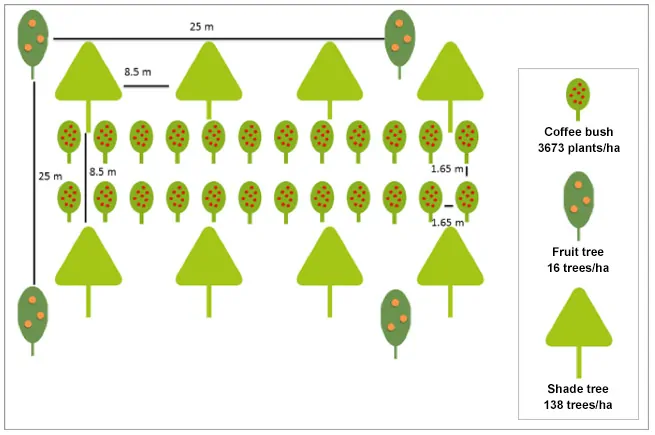
Agroforestry model where larger trees, coffee bushes and fruit trees are planted together.
In the example above, the tall trees provide shade for the light-sensitive coffee bushes, but the plants and trees also provide other positive benefits to each other. Both the trees and the coffee bushes act as carbon sinks, while the harvested fruit can be sold on the local market or used for own consumption. The project is being monitored and verified to ensure that the plantings are going well, both through physical visits and advanced mapping methods using satellite imagery.
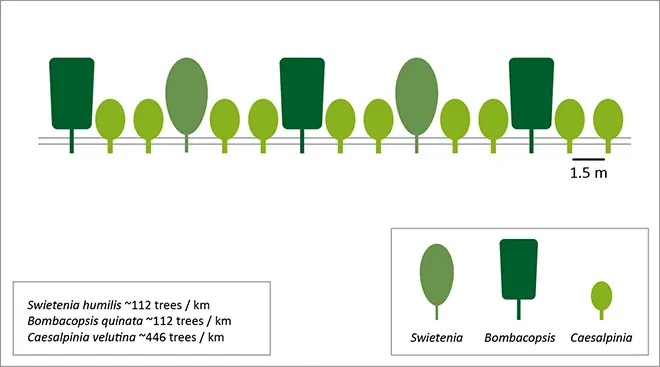
Model where trees are used to delimit for example plantations or yards.
Agroforestry
In the agroforestry model presented above, trees are used as a form of living fence. Planted near crops, the trees provide benefits in terms of shade, reduced risk of soil erosion and crop wash-off in the event of heavy rainfall. In this method, different types of trees are planted with different purposes and characteristics. Smaller and faster-growing trees can be thinned out over time to become fodder for animals.
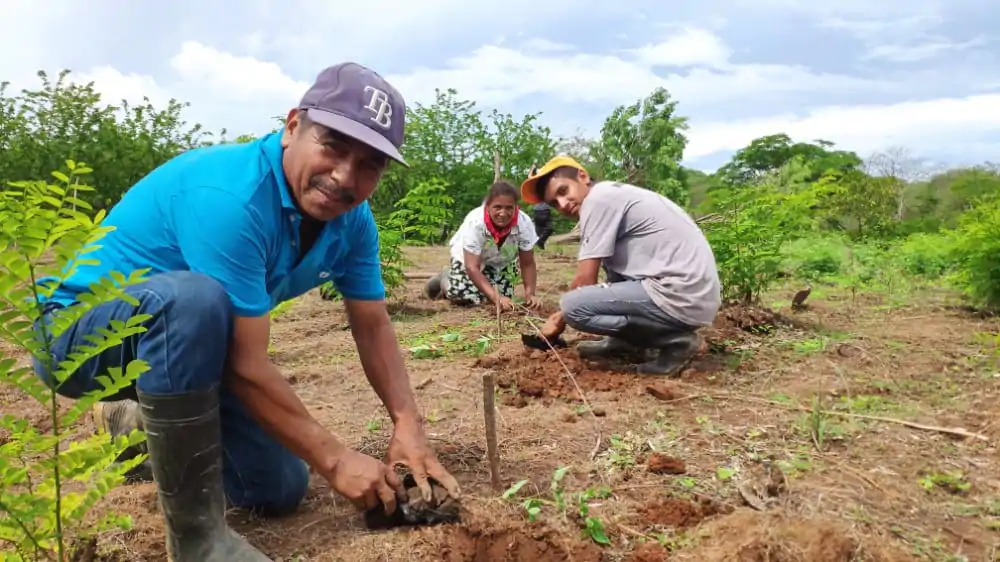
Smallholder farmers in the CommuniTree project in Nicaragua.
Climate project with many additional benefits
Small-scale farmers can and should play an important role in the fight against climate change. At the same time, our carbon offset projects are based on small scale. The most important thing is to reduce emissions, immediately and in the long term, to have a chance of reaching the Paris Agreement's 1.5-degree target, while taking care of emissions already in the atmosphere. We also need to use a wide range of measures to sequester carbon, and never get stuck on one method. Agroforestry is an important method to have in our toolbox.
References:
- CommuniTree Nicaragua
- Planting models, agroforestry
- Tightening the Net, Oxfam
- Taking Root, Agroforestry and Coffee production
Note: For a long time, saying that a company “offsets” its emissions was a popular phrase in corporate sustainability communications. Since 2024, ZeroMission—like other players in our industry—has instead started referring to this practice as carbon offsetting a term we feel better describes what it’s actually about. Read more here.