On May 25, 2019, Department Festival took place in the Slakthus area of Stockholm. Since its inception, the electronic dance festival has worked to minimize its climate impact, among other things by serving only vegetarian and vegan food, collaborating with local partners and locating the festival in a central urban environment to reduce travel distances. As the next step in the sustainability work, the decision was made to analyze the entire festival's carbon footprint with the help of ZeroMission according to the ISO 14067 standard and then offset 125% of the emissions to become the first music festival in the world to become climate positive.
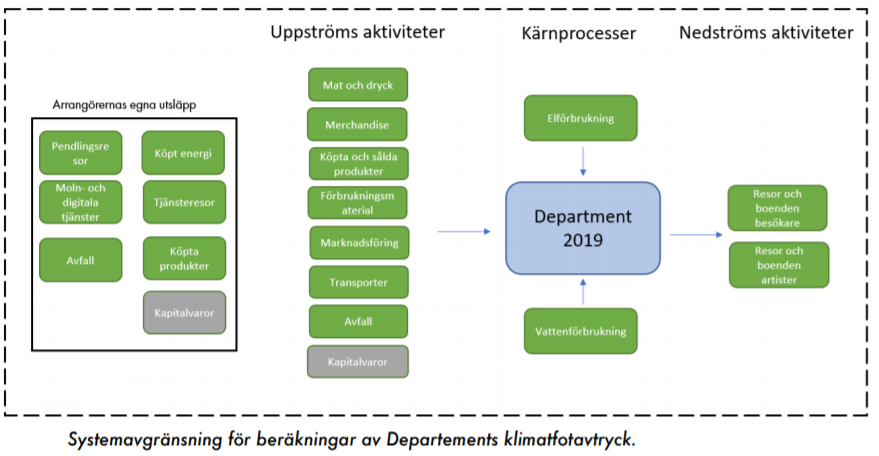
Sustainability issues have become a priority for many Swedish music festivals in recent years. A survey by Swedish Radio's Kulturnytt shows that 9 out of 10 festivals studied have set environmental targets and are working to reduce their carbon footprint. But there is still uncertainty about what is meant by this. What should be included and how should it be calculated? Is it only what happens within the festival area that should be included in the festival's carbon footprint or should marketing, artists' and visitors' travel and accommodation, organizers' daily activities, etc. also be included? How to set the system boundaries will be crucial for comparability but also for knowing where in the value chain the largest emissions occur and how to target measures to minimize them.
The lack of standardized methodologies tailored to festivals led us to choose for the Department Festival the guidance formulated in the chosen standard for climate neutrality: PAS 2060, namely that; all activities whose exclusion would lead to the event not being able to be organized or being fundamentally changed from the intended outcome and which may generate emissions during any stage of its life cycle of the event, shall be included.
The analysis, which can be read in full here, shows that close to 50% of emissions come from visitor travel and accommodation. This is despite the fact that 91% of all visitors traveled from the Mälardalen area, and over 50% of all visitors traveled solely by public transport. The figure below shows the 5 largest sources of emissions that were dominant for the outcome and are thus priority areas to work on for future festivals.
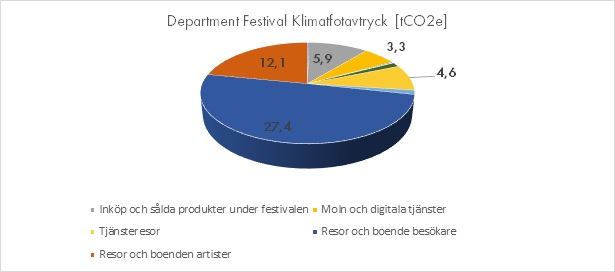
In the face of climate change, critics sometimes say that music festivals are an unnecessary form of hedonism, resulting in overconsumption, littering and long flights. But the climate analysis of the Department Festival shows that with the right measures and awareness, emissions can be kept down. Per individual festival visitor, emissions were 22.3 kg CO2e, which is 37 times lower than the climate impact of a return flight to Barcelona. While the link needs further investigation, it is clear that there is a significant climate saving if music fans choose to attend local events instead of seeing their favorite artists at festivals abroad. In other words, bringing the artists to the audience instead of the other way around.