Five characteristics of companies offsetting through the purchase of carbon credits
October 21, 2023
Over the past year, no less than three reports have been published on the same theme - companies that offset are simultaneously reducing their own greenhouse gas emissions faster than companies that do not offset. Here we look at some more characteristics of these companies.
Ecosystem Marketplace recently released the report All in on Climate: The Role of Carbon Credits in Corporate Climate Strategies. The analysis looks specifically at the climate-related behavior of companies that purchase voluntary project-based carbon credits for their own use compared to companies that are not engaged in the voluntary carbon credit market. Previous reports this year have come from Trove Research - Corporate emission performance and the use of carbon credits, and from Sylvera - Carbon Credits: Permission to Pollute, or Pivotal for Progress? In this article, we present five findings from these different studies.
Unfortunately, there are a number of claims about the purchase of voluntary carbon credits by companies that appear again and again in various articles. Despite studies over the years showing that the claims are not true, they continue to appear as truths. Rather, the companies that buy the credits and 'offset' through them are the ones leading the way on climate action. So what makes these companies stand out in their climate leadership?
- faster reduction of own greenhouse gas emissions
- finances climate projects outside its own value chain (beyond value chain mitigation)
- transparent communication of its emissions and measures
The result of the above is that companies that have taken the lead are inspiring other companies to step up their game. What the three reports have in common is that they all show that companies that buy carbon credits on the voluntary market have higher climate ambitions than companies that do not buy credits. Here are five things that stand out.
1. companies that buy carbon credits reduce their own emissions faster
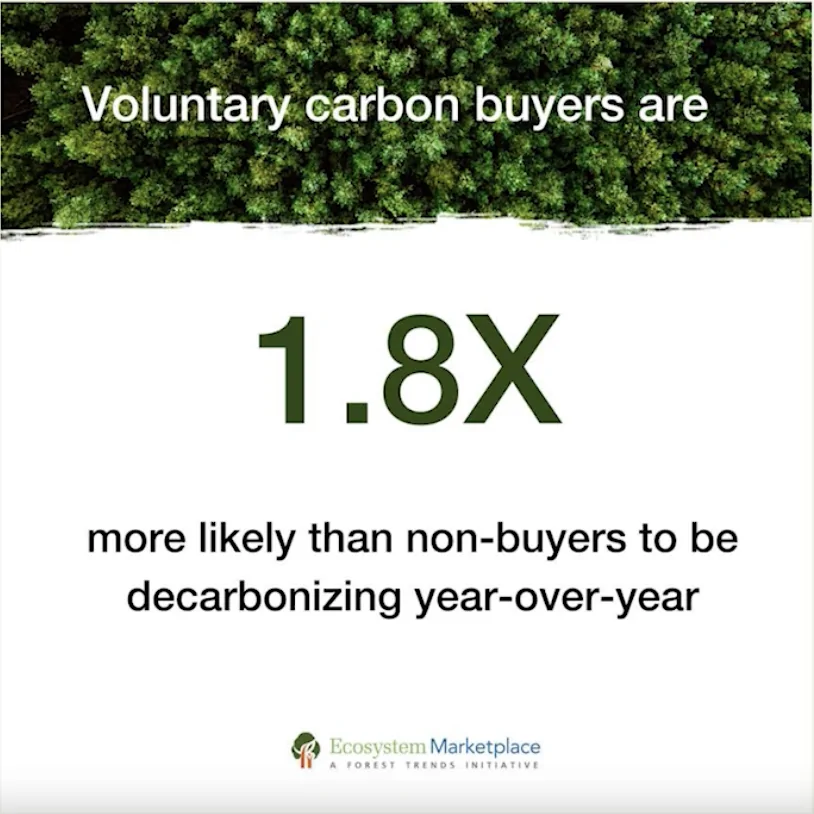
Ecosystems Marketplace research shows that nearly 60% of companies that purchase carbon credits report faster year-on-year greenhouse gas emission reductions compared to other companies. The Sylvera report shows that companies that purchase carbon credits simultaneously reduce Scope 1 and 2 emissions by 6.2% per year compared to 3.4% for companies that do not.
So - companies that offset reduce their emissions almost twice as fast as those that do not offset.
2. Companies with the climate leader jersey choose quality
The report from Trove Research shows that companies that buy more expensive, high-quality credits also reduce their own emissions faster than those that buy cheaper, lower-quality credits. At ZeroMission , we offer credits in different price ranges, but most are what we call 'high integrity credits'. We are the only company in Sweden to sell credits verified by Plan Vivo and Fairtrade. If you choose to finance projects that are verified by one of these, they are of high quality.
3. companies that buy carbon credits are more transparent about their climate work
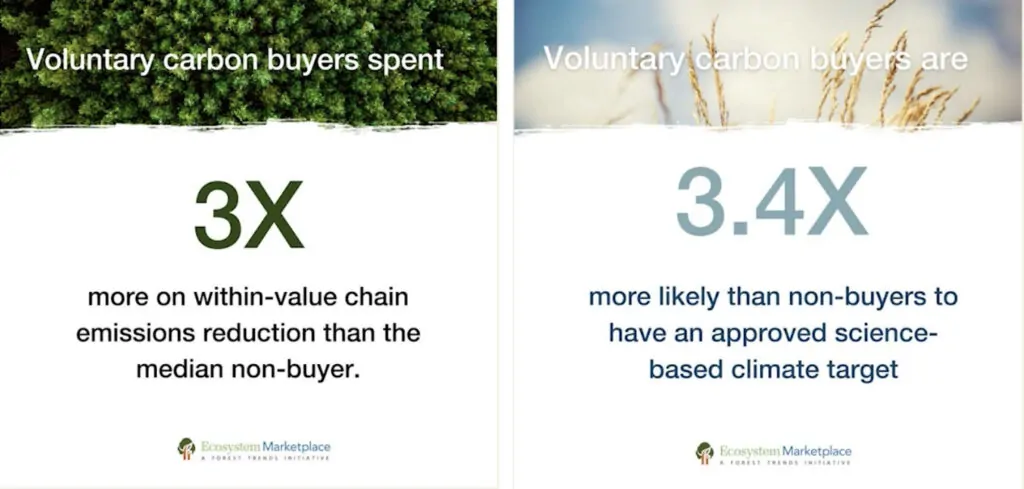
Transparency is one of the cornerstones of climate action - carbon accounting and sustainability reports create an openness that makes it easy for others to follow the progress of a company on its journey towards net zero. The Ecosystems Marketplace survey shows that companies that buy carbon credits are more likely than others to disclose their climate performance. They are 3 times more likely to include Scope 3 in their climate calculations, which is significantly more ambitious than just Scope 1 and 2.
The Ecosystems Marketplace survey also shows that buyers of carbon credits are 3.4 times more likely to set science-based targets under the Science Based Targets Initiative. In other words, it's companies that are setting targets and transparent in all their climate work.
4. Offsetting companies are more engaged throughout the value chain
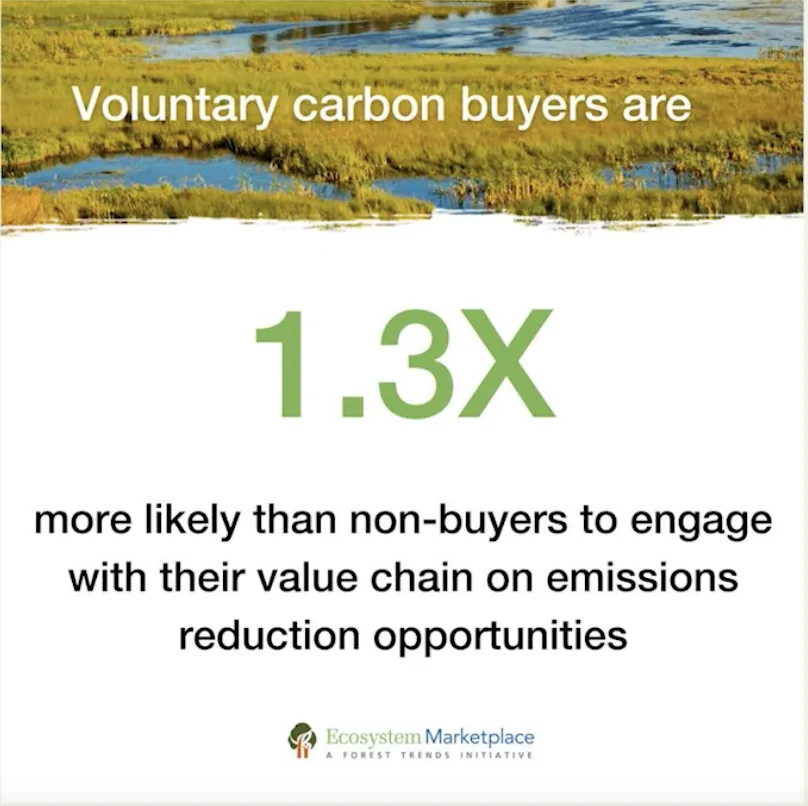
Companies wearing the climate leader jersey have realized that they are not an island, but see the need to take a helicopter perspective on climate work. This includes engaging with the entire value chain, both on the supply side and on the customer side. The Ecosystems Marketplace survey shows that buyers of carbon credits are 1.3 times more engaged across the value chain than other companies. In other words, they are not content with offsetting, but are actively working both upstream and downstream to reduce their climate impact. This is where it becomes clear that companies with good quality climate calculations have a good overview of the sources of emissions in all three scopes and can therefore also do something about them.
5. Companies that offset their emissions do not buy their way out
The Ecosystems Marketplace survey shows that for the companies included in the study, carbon offsets represent only 2% of total emissions across all scopes. In other words, the companies buying carbon credits have not tried to escape responsibility for all their emissions. However, for the sake of the climate, we wish the figure was higher.
Carbon offsetting cannot replace substantial reductions in greenhouse gas emissions, but for those emissions that have not yet been avoided, it is still effective in the short term. At ZeroMission , we have long seen the purchase of carbon credits as an internal price to make the invisible waste visible in the accounts. Voluntarily taking on an extra cost for emissions creates strong incentives to reduce them as soon as possible and get rid of the cost. Among our customers, it is clear that 'both' is more the rule than 'instead of'. Buying carbon credits goes hand in hand with active and ambitious climate action (learn more about the next generation of carbon credits with innovative approaches).
To reach net-zero according to the Science Based Targets Initiatives, at least 90% of emissions in all scopes must be eliminated and the remaining up to 10% can be balanced against various types of carbon storage. ZeroMission assists our customers with knowledge and projects where we offer high-quality credits for this purpose.
The images in the article come from the Ecosystem Marketplace presentation of its report.
The illustration above was taken at Mikoko Pamoja, an award-winning Plan Vivo verified project conserving and replanting mangrove forests on the Kenyan coast. ZeroMission offers credits in the project and visited it in May to see and evaluate on site.
Sources: