Calculating like a climate strategist
August 8, 2023
ZeroMission works to help companies and organizations, large and small, to calculate their climate impact. To do this, we use Our Impacts, our web-based platform for climate calculations. We caught up with Olivia, Climate Strategist in the Strategy and Calculations team, to let her tell us a bit about the platform.
Hi Olivia! You work as a climate strategist with us and have done so since October last year. What is it really like?
I haven't given it much thought, to be honest! But it's fun to help companies calculate their climate impact and to do deeper analysis. We also have very nice customers that we work with.
You must have learned a lot of new things since you started.
Yes, I have gained an insight into how different types of companies work and their challenges when it comes to the climate area. I have also learned more about the Greenhouse Gas Protocol, I did climate calculations before I came to ZeroMission but not to the same extent. Having a platform that automatically calculates for you is much easier and more convenient for you as a climate strategist than sitting in an Excel document and connecting cells. Here, the workflow is much smoother because everything is in one place. Our platform Our Impacts has a lot of good features when it comes to reporting data and providing feedback, for example.
Wow, that sounds interesting. Can you tell us more about Our Impacts?
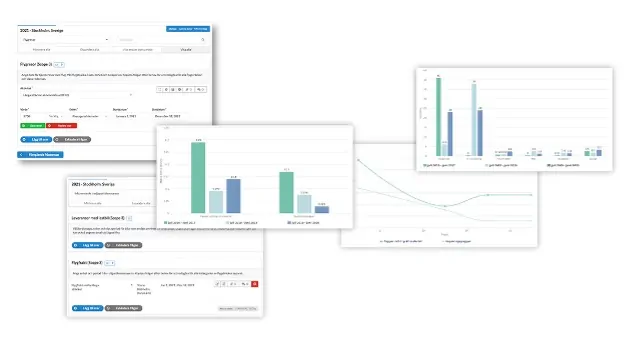
Well ok, I can start from the beginning. We have a web-based platform called Our Impacts to help companies calculate their greenhouse gas emissions. The platform itself has over 30,000 verified emission factors to calculate the climate impact of a variety of activities! Everything is collected in one place, with supporting data, estimates, assumptions and possible comments.
Is everything activity-based?
At ZeroMission , we mainly work with activity-based data, or real data (e.g. 200 liters of gasoline), precisely because it is the data that gives the most accurate picture of what your emissions are. The other type of data is spend- or cost-based, i.e. data based on how much things have cost (for example, electricity for SEK 100 000). It can be used but in such cases more for the purpose of getting an idea of the size of emissions or how to prioritize areas and sources of emissions.
Spend data should not be used to calculate emissions on an annual basis, as it is not possible to see how emissions are changing. For example, the cost of electricity has increased a lot in the last year, but this does not mean that emissions have automatically increased by the same amount. In fact, your electricity consumption may have decreased through energy efficiency measures, but that won't be reflected in the increase in electricity prices. Sad, isn't it?
But how does it actually work?
All activities and emission factors are available in the platform, so the customer selects the activity that has been done and reports the corresponding data in the platform. How many liters of gasoline were purchased during the year? How many hotel nights were spent and in which city/country/continent? How many computers were purchased during the year? If the customer has a specific activity with a specific emission factor, we can of course add it to the platform.
Okay, okay. But if you were to highlight the three best things about Our Impacts, what would they be?
So, one thing I have to say is this about the human factor. There is a great risk of error if calculations are done manually in Excel, for example, that you have connected the wrong cells or forgotten to divide by 1000 or the like. That bit is done automatically in the platform, so the risk of errors in terms of calculation is greatly reduced. I also like that everything is collected in one place, that you can make comparisons between different years directly in the platform and different categories that customers measure. Of course, I also love the wide range of emission factors available!
I was thinking about the fact that many organizations find it difficult to include everything in their Scope 3. How do you think one should think there?
If you are just starting to calculate climate change, it is common among our customers to start with the major categories for their business, and then add more categories the following year. Then the customer gets into routines to ask for data from their suppliers and sets internal structures for data collection. We see that the first year a customer starts climate calculations is the trickiest and takes the most time, then it becomes easier, smoother and flows quite well.
That makes sense. What does the actual process look like if you want to start climate calculations with ZeroMission in Our Impacts?
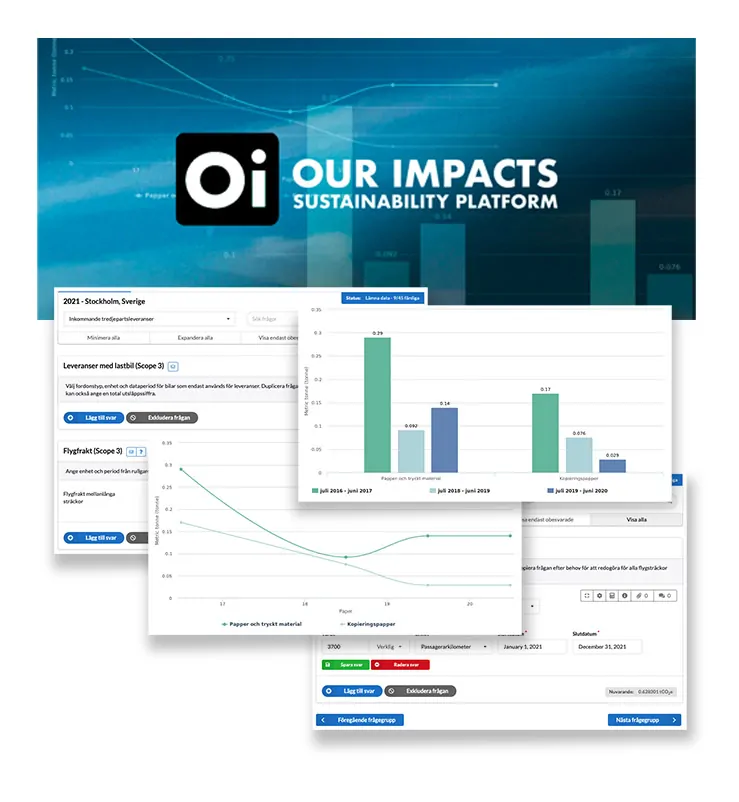
First, we do a kind of feasibility study and check which areas to include. Scopes 1 and 2 are always included, but what is it in Scope 3 that should be included? Sometimes the customer is involved and sometimes we help, then we discuss and take the categories that are relevant. After we have set a question structure, the customer collects the data and documentation needed and reports into the platform. For traceability, we always recommend that they write comments and include other important information. This facilitates our quality review where we make sure everything looks good. If you have reported several years with us, we can immediately see if something is very different, for example, if air travel has increased by three thousand percent, it may not be entirely reasonable. It may be because there happened to be an extra zero when reporting.
When everything looks good, we close the carbon footprint and send out reports to the customer, and present the results. The carbon footprint can then form the basis for an analysis and reduction plan of emissions. We can also help in this work by facilitating workshops.
Cool! As a final question, what do you think is the best thing about working as a climate strategist?
Wow! I haven't thought about that either, haha. But it's fun to work with a wide range of many different types of companies. It's also fun to see that many people want to do something for the climate. Again, our customers are very nice as previously mentioned, at least mine.