Project visit Central America – Part 1 of 3
November 27, 2023
"THE TREES THAT GROW". Mexico, November 6-8, 2023.
At ZeroMission , we travel to the carbon offset projects we work with because the visits contribute to increased understanding, transparency and knowledge exchange between us and project participants. In November this year, our colleagues Cecilia Hall, climate strategist, and Henrik Juhlin, CEO of ZeroMission, traveled to Central America. Here you can read the first part of their travel report.
Scolel'te project - background
Scolel'te, which means "the growing tree" in the Mayan language tzeltal, was founded by, among others, Elsa Esquivel Bazán, an expert in agroecology and ecosystems and director of the organization AMBIOin 1994 and the project was certified in 1997. The project is the first carbon offset project in the world to be certified in the voluntary carbon offset market, and has been certified under the Plan Vivo standard since 1997. AMBIO runs the project locally.
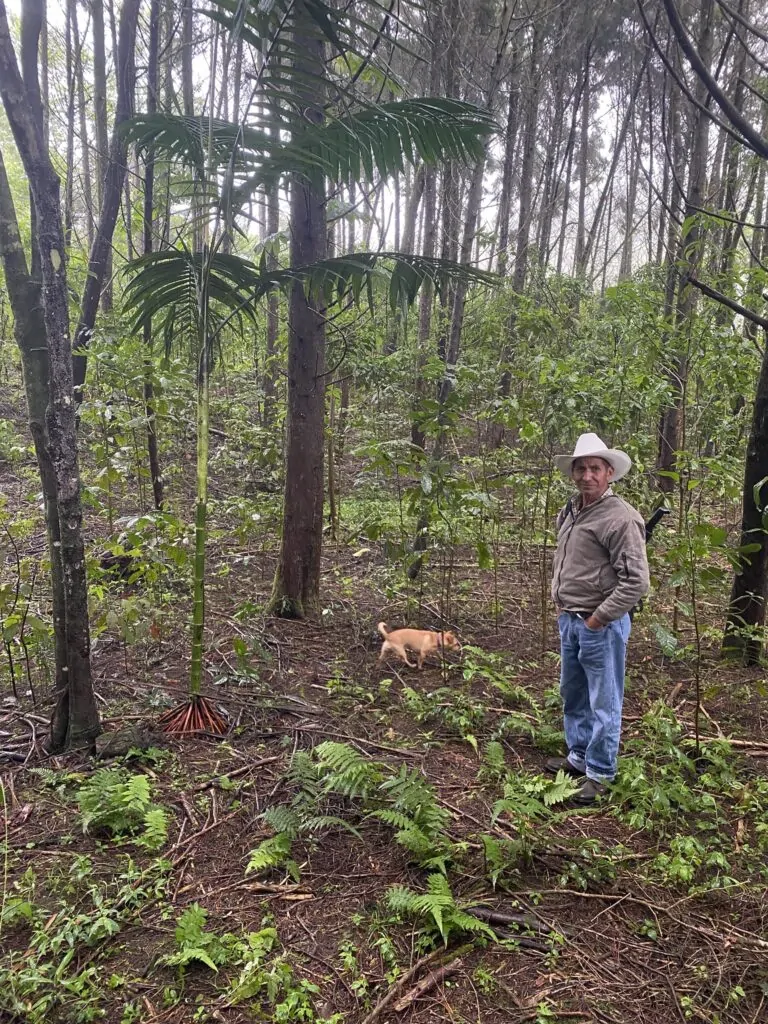
Don Alberto on his land under the trees he planted since joining the Scolel'te project in 2005.
It is from the model of Scolel'te and other early projects that Plan Vivo has built its standard. The essence of the standard is that the smallholders participating in the project should be able to care for and manage their land in a sustainable way, while having the freedom of choice and opportunity to adapt their lives and activities over time. This is so that their land use and farming practices are holistically sustainable in the long term, not the planting of forests that then risk being cut down. For each smallholder who joins the project, a so-called "living plan" (or Plan Vivo in Spanish) is made where representatives from the project organization together with the smallholder look at what kind of system is suitable for each individual and land.
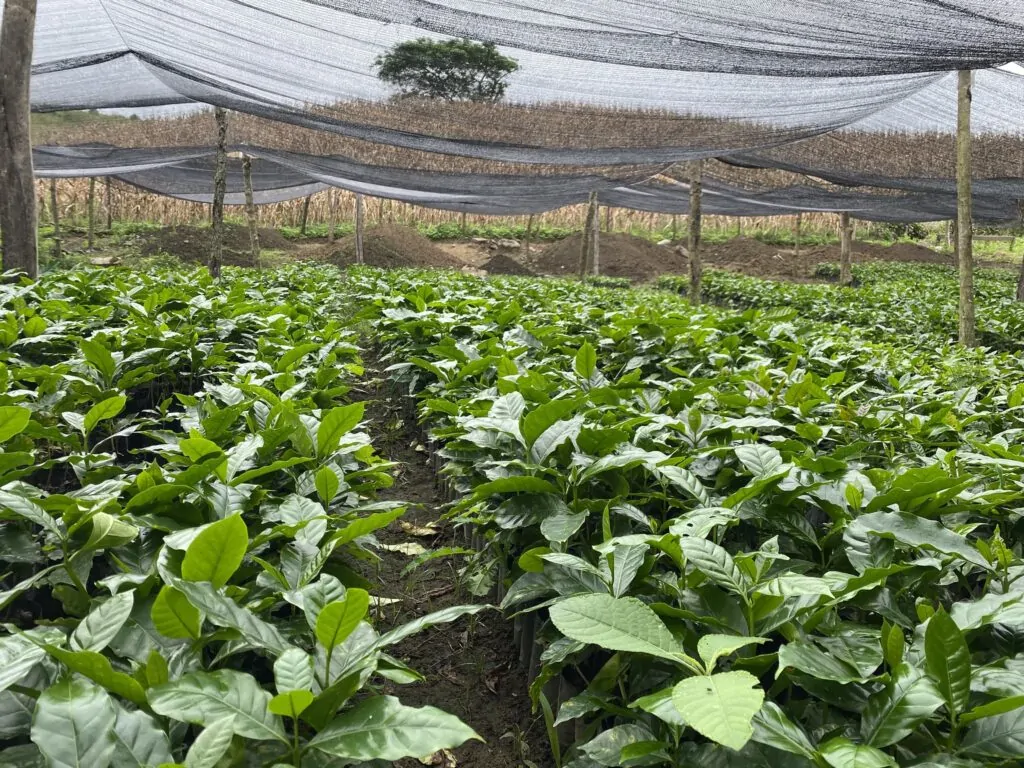
A project nursery raising coffee plants. The coffee bush is sensitive to changes in climate, and many project participants are already experiencing problems with their crops due to a fungus, the 'royas fungus', which attacks the bushes.
Scolel'te is made up of more than 100 smallholders across the state of Chiapas in southern Mexico. The project participants sign long-term contracts with the organization AMBIO that extend over 30-40 years, which is the limit of what is allowed under Mexican law. The project participants are small-scale farmers and landowners. Many of them are gathered in local groups, called "ejidos" (or "communities"). The concept of ejidos is unique to Mexico and allows landowners to come together and form a legal entity to gain better rights, while requiring the ejido to follow certain rules on how they can, for example, sell or transfer land owned within it.
Summary of the project visit - Henry's words
"It is great to have been able to visit the organization AMBIO and the Scolel'te project, which is the world's oldest carbon offset project with over 25 years of operation. The fact that the project has been around for so long is definitely proof that what they do is reliable, and that everyone who buys carbon credits from the project is making a long-term difference for the climate and for the people who participate.
I myself was very moved to see both how the project participants live and the enormously strong and colorful culture they have in this area. It is also touching to see how proud everyone is and that they really want to show and tell their story of how they planted the trees and watched them grow, and what a difference they made to their lives.
For all those who are critical of carbon offsetting, I hope that one day they can visit projects like this and meet the people behind AMBIO, see their commitment and learn from their knowledge, which is both great and genuine."
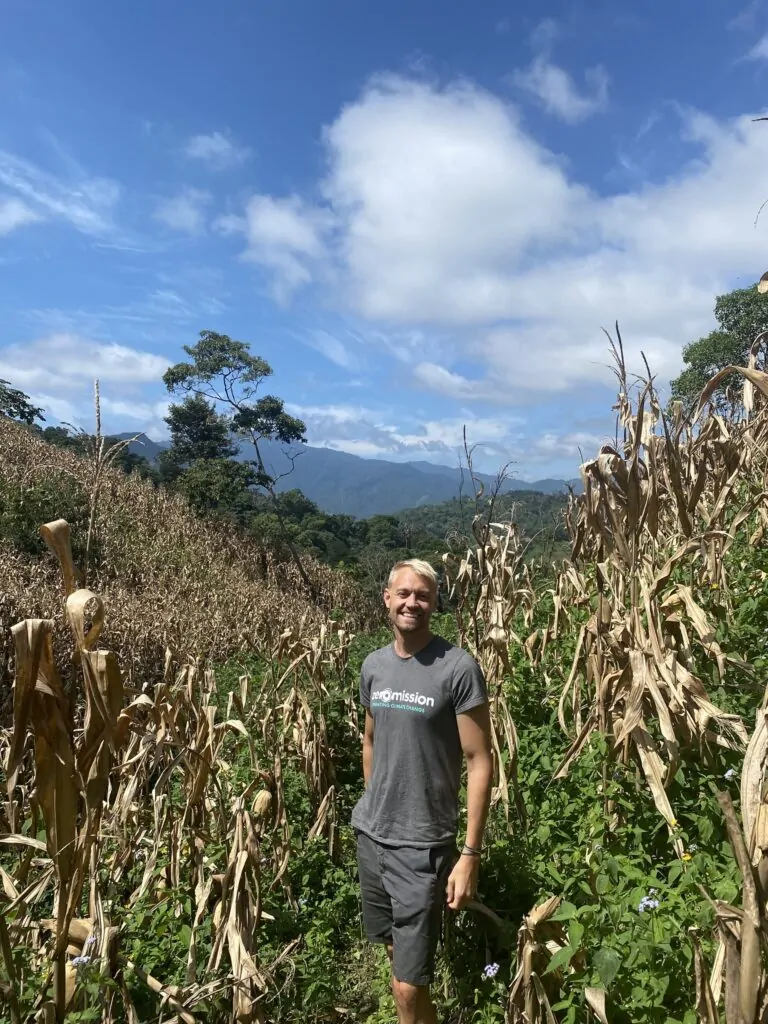
Henrik Juhlin, CEO of ZeroMission.
The visit
Tziscao
We started the project visit in San Cristobal de las Casas, near the border with Guatemala. At AMBIO, the organization that develops and runs the Scolel'te project since 1994, we first met Rubén Trujillo, a forestry engineer who has worked for AMBIO for 7 years, and Elsa Esquivel Bazán, who co-founded both Scolel'te and AMBIO.
It is a large area we will visit and the first village is about 4 hours away. On the way we will have time to learn a lot about the nature and culture of the area. Nature is a central part of Mayan culture, and Rubén tells us that in Mayan culture there is a belief that everything alive, but also every tree and every stone, has a soul. The descendants of the Mayans also believe that when you are born, your soul splits in two. One part stays with you, but the other part of you is in nature and for you to feel whole you need to be in constant contact with the other part of your soul. As we drive through the landscape, which is at such a high altitude that the clouds are wrapped tightly around the towering peaks, we are reminded of the movie Avatar [set on a planet where jungle-covered floating mountains with billowing greenery and hanging vines float among the clouds above a landscape covered in water, ed. There are 72 different conifers in Mexico and as we drive, Rubén points out and names the different varieties we pass. Rubén himself grew up in an ejido and his father worked in forestry, which means he is well aware of the challenges and opportunities facing project participants. Something he describes as a great advantage when he travels around and meets leaders from these ejidos.
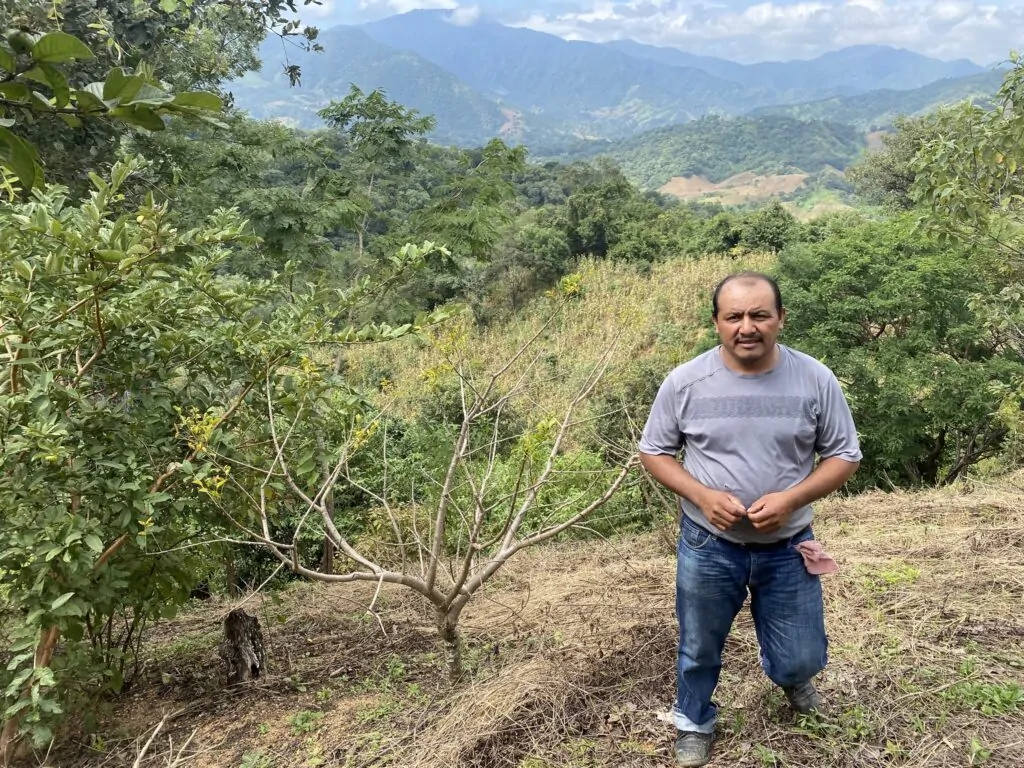
Manuel de Jesús Pascasio Sanches has two hectares of land where he mostly plants coffee but also different types of fruit trees and avocados. Over the years, like most farmers, he has encountered problems with his crop, but thanks to the help and support of AMBIO, his plants are now growing well.
Our first visit is to an ejido in the Tziscao area of the Lagunas de Montebello National Park, which is only a few kilometers from the Guatemalan border. The national park is built around 54 separate lakes and is protected by the Mexican government, but around the park there is an important buffer zone that is not protected. The buffer zone is very important for maintaining biodiversity and as protection against natural disasters and human impact in the area. ejidon, which is involved in the project, has together reforested about 50 ha of land within this important buffer zone.
It is raining heavily in the area as we approach the project, although the rainy season should have ended just over a month ago. Elsa tells us that it is raining much more in the area now than before due to climate change, but also that the rain is coming more in bursts and causing flooding. This is causing big problems for those with maize or coffee crops. Coffee plants in particular across the region have been affected by a fungus, the royas fungus, which has forced many smallholders to abandon their crops. Many coffee plantations are vulnerable to climate change as the plants require a certain climate and humidity. Through AMBIO, project participants are working with a university in Chiapas to make improvements to crops (such as coffee and corn) to make them more resilient. But this is something that takes time and can yield results in the medium and long term, while farmers need results and options now for their survival.
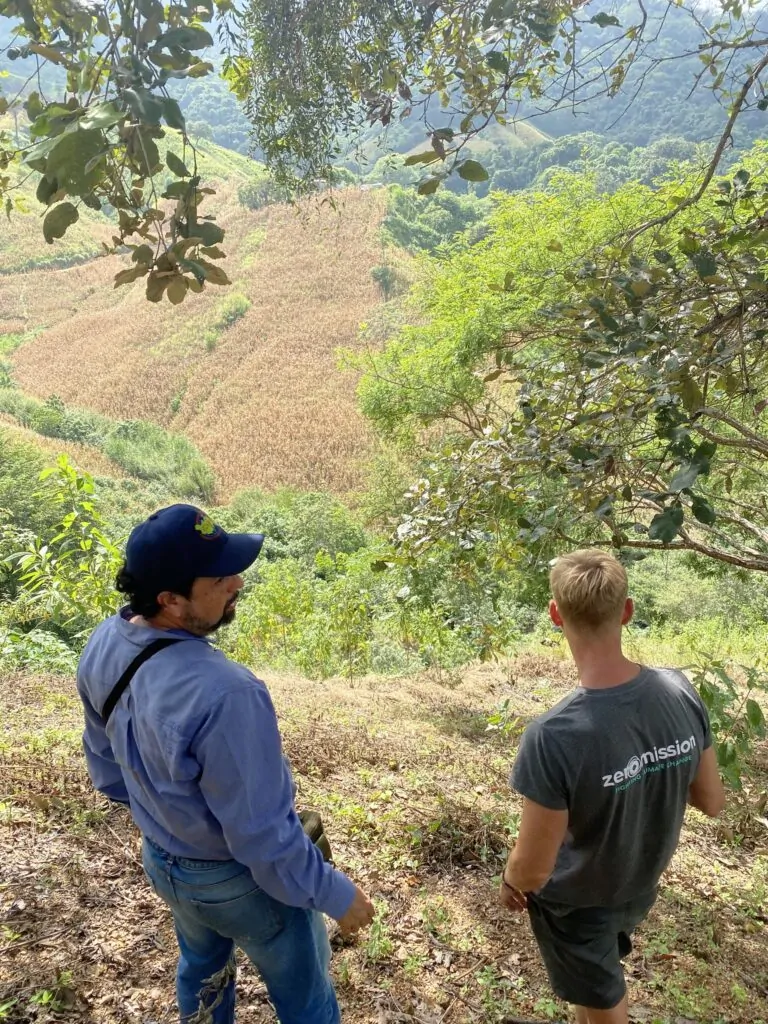
Henrik and Israel, who work at AMBIO, look out over Manuel's land where he has planted many different types of fruit trees and crops.
We meet the project participants Alberto Morales, Don Alberto, who has been involved in Scolel'te since 2005, Don Andrés who has been involved in the project for 2 years with his son Rosenberg, and Señora Lesvía whose husband died but who now owns the land connected to the project. Don Andrés describes how the best thing about the project is that it helps to keep the trees healthy which is a key for their life, survival and culture in the long term. He also says that sometimes invitations come from other project organizations that promise a lot of money initially but provide no long-term incentive or follow-up and then abandon them once they get their money. This has meant that many smallholders have felt cheated and have cut down the forest again before it has grown up.
When we are out and about on Don Alberto's, Don Andreas' and Señora Lesvía's land and they show and tell us about the trees they have planted and how old they are, it is with enormous pride. We see trees ranging from 1 year old to almost fully grown 16 year old trees. The pride of working with something that benefits both them, nature and biodiversity is great and we feel how happy they are to show what they do.
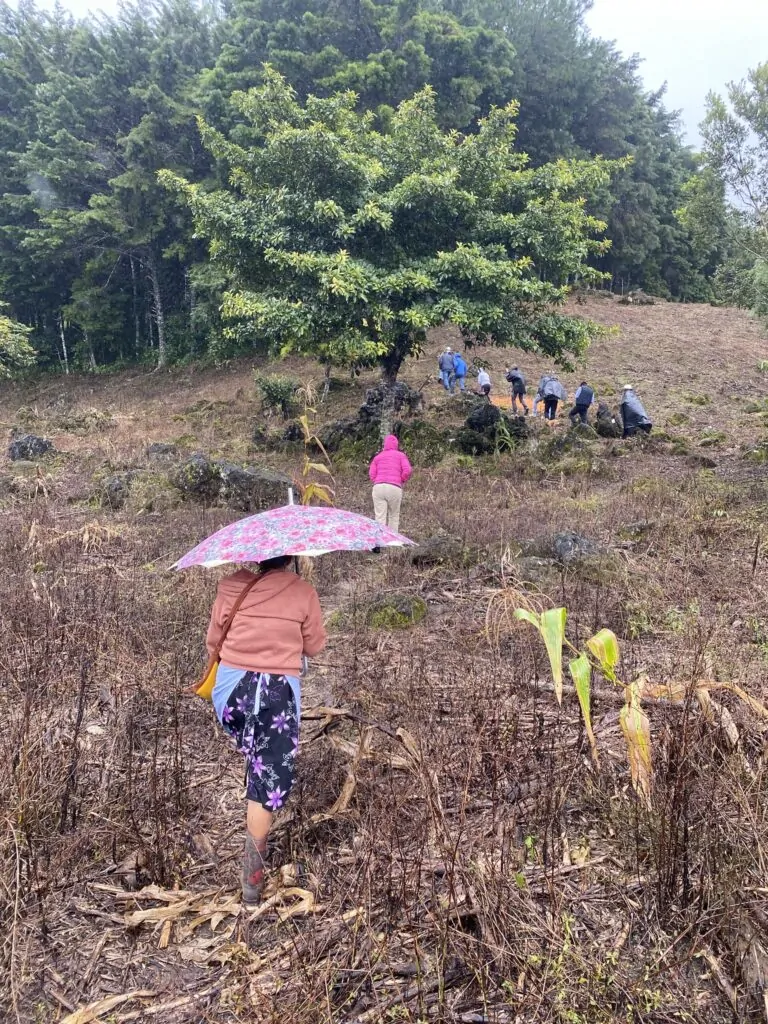
Where the trees start is the boundary of the project area, giving a visually clear picture of the impact of the project locally.
The project participants, like all farmers, live seasonally and depend entirely on the weather for their livelihoods. They talk seriously about climate change, which has become very real to them, and they want to do what they can to protect themselves and future generations from its effects.
Coapilla
Our next visit is to a nursery in the Coapilla area. Ejidon, which runs the nursery with the support of AMBIO and Scolel'te, is also active in forestry. Some of the plants will therefore go to reforest areas that they have cut down. Coppicing is not used, instead only individual trees are removed. They say that they save "arbóles padres" and "arbóles madres" (daddy trees and mommy trees) that are very old and seed themselves and give regrowth around them.
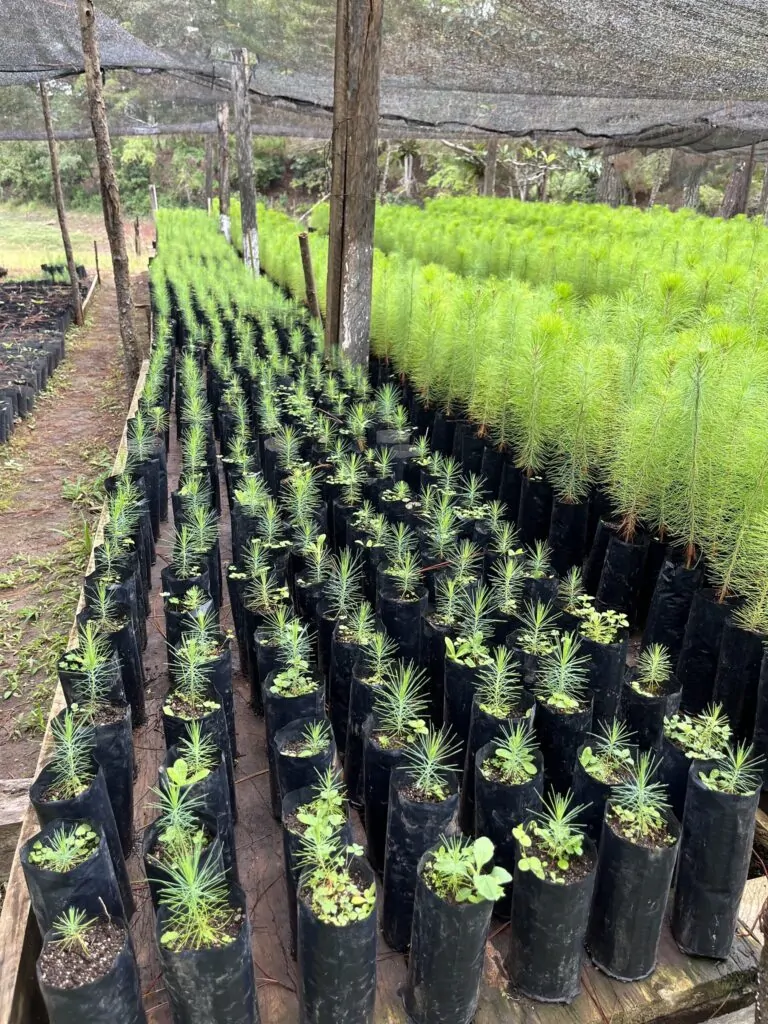
We learned that it costs about 10-15 pesos to buy a seedling. If they raise the seedlings themselves, they cost about 5 pesos per seedling, so a big saving! If there are plants left over that are not used, they are sent to other participants in Scolel'te.
The seedlings that are not used to replant the felled forest are used to reforest new areas for Scolel'te. This year, about 35,000 seedlings have been planted within the project on an area of 25 ha. The seedlings we see are about 8 months old and are ready to be planted out this November. Until a few years ago, the Mexican government helped to finance the nursery and reforestation, but since the government cut its budget for nature conservation by 75%, the support is now gone, so it is thanks to AMBIO that they can continue with their activities. We pick up some seedlings and drive to one of the land areas where the reforestation is done and get to plant some of the trees ourselves.
Villa Flores/Dos Arbolitos
For the last visit, we join Israel Cárdenas, who has been a forest engineer at AMBIO for 12 years. He takes us to some private smallholders outside Villa Flores in the Sierra Madre mountain range. He tells us that about a third of all rain in Mexico falls in this area and that it is incredibly important for all of Mexico.
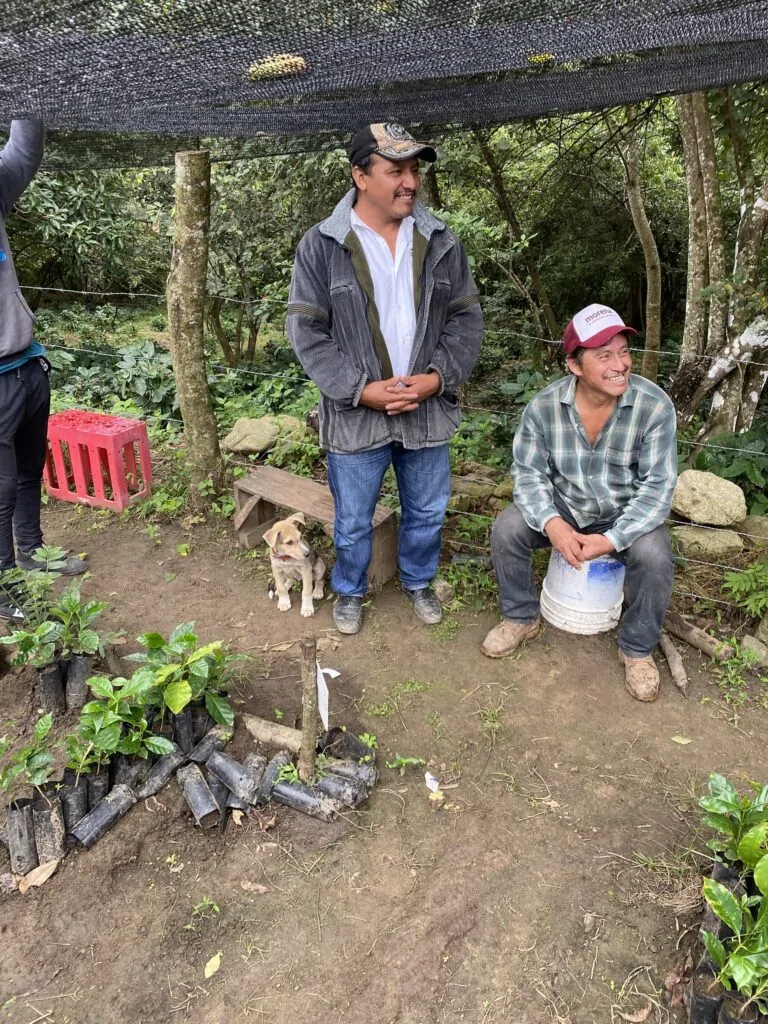
At the coffee nursery we met Manuel, René, Iván and Alexander, plus the little puppy Tígre.
Israel is incredibly passionate about the forest and is nicknamed 'The Birdman' (El Pajarero) because he is so interested in birds. He also explains in detail how important each tree in the area is for their different properties, such as purifying water in the rivers, providing food for birds or preventing soil erosion and binding the nutrients in the soil that plants can then take up. Israel also tells a story from his first job as a forester, where he was tasked with putting a nail in trees to mark them. Before putting up each nail, he felt he needed to hug the tree as an apology for hurting it.
We follow two farmers out on their tree plantations. They also have a small nursery together in the area, which they proudly show off. Both have previously had only maize on their land, but have now planted trees and just started planting both coffee plants and maize together with the trees. Right at planting, they put out about 600 tree seedlings per hectare, but after a few years about half of the seedlings are thinned out. In an older area, which has existed for over 10 years, we see that the trees are large and they explain that there are about 200 of the trees left. Between these trees there is now a mix of coffee plants and mangoes and even now the occasional avocado tree.
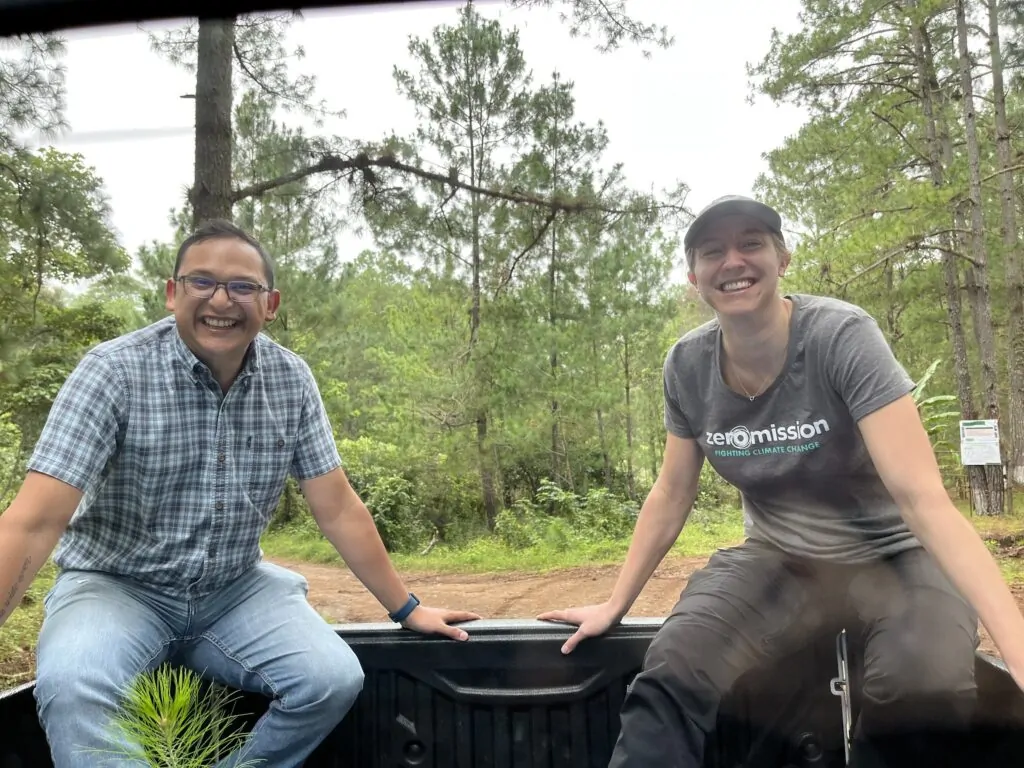
We got to ride in the back of the truck and it was a great feeling of freedom! Here with our translator, guide and friend, Iván.
Each year, data on tree health, diameter and height is collected from all areas involved in the project. In some cases, the biodiversity of the area is also monitored, but this is difficult and expensive so the primary focus is on data collection on the trees and their ability to absorb carbon dioxide. All data is then verified by AMBIO, which now has a large database and can identify if there is any data that looks strange or anomalous. This way they can quickly see if any project participants are cheating with their plantings. Cheating was a problem in the beginning, but now they detect any anomaly early on so no one dares to do it anymore. Then they risk being excluded from the project. All data collected is also third-party verified by ANCE, a governmental certification and auditing organization in Mexico, every five years. Measurements and monitoring are done for 30 years after the trees are planted.