Outlook 2026 – a year of sustainability-driven business development
January 15, 2026
What can you expect from the coming climate year? What will happen with net-zero directives and regulations, and how will this affect your business? ZeroMission CEO Henrik Juhlin shares his outlook for the coming year and provides updates that can help you in your climate work.
Three predictions for 2026:
- Climate leadership driven by will, strategy, and business value
- New carbon credit frameworks move from concept to operational reality
- Swedish companies see major business opportunities in the transition
Less than a year ago, CSRD was CSRD the majority of Swedish companies were working to implement. The expectation was that it would lead to major strides forward in corporate climate reporting and sustainability work. However, this has been swept away during the year, along with many other European regulations on sustainability and climate, such as CSDDD and EUDR, to name a few.
Sustainability-driven business development
When regulation weakens or stalls, responsibility clearly shifts to companies that are willing to integrate climate and environmental goals into key business decisions, operations, and risk management. Therefore, sustainability in 2026 will be defined less by bold commitments and more by quiet, disciplined execution.
In 2025, several frameworks moved from concept to near operational reality, including the EU Carbon Removal Certification Framework (CRCF). The first CRCF-certified units can be expected to reach the market in 2026.
My view is that the focus will remain on integrating sustainability into how businesses are actually run. In 2026, climate leadership will be driven by desire, long-term strategy, and business value, rather than regulatory compliance.
Although the business community is once again leading the way, progress is still being made politically, particularly with regard to the use of carbon credits, which we hope to see incorporated even more widely in 2026. In 2025, several frameworks went from concept to near operational reality, including the EU's Carbon Removal Certification Framework (CRCF) and its first methodologies, which will likely lead to the first CRCF-certified units reaching the market in 2026.
The ongoing update of the net zero standard within Science Based Targets is expected to be launched in early 2026, which will provide significantly increased incentives for companies to purchase carbon credits for their ongoing emissions. Another update to the standard is that it is now possible to use nature-based carbon credits to achieve net zero. ISO is also expected to adopt a new net zero standard in 2026, which also includes clarifications and increased incentives for the use of nature-based carbon credits.
I hope that 2026 will be a year of policy deliveries that strengthen both public and private capital for projects that capture and sequester carbon dioxide from the atmosphere.
Carbon dioxide emissions into the atmosphere
At the same time, warning lights around us are flashing more and more intensely—2025 was a grim year for the climate. We crossed the planet's first irreversible "tipping point" as coral reefs have now been so badly damaged by rising water temperatures due to human activity that scientists believe they will not be able to recover. 2025 is also the year when we exceed 7 of the 9 planetary boundaries.
The average temperature in recent years exceeds 1.5 degrees, which is worse than the worst-case scenarios that climate researchers developed just 5-10 years ago. The amount of carbon dioxide waste that we humans have released into the atmosphere continues to rise, with the US far ahead in the global rankings. Although global net deforestation has decreased over the past 10 years, the global rate of deforestation is over 4 million hectares per year, which is equivalent to an area the size of the entire country of Denmark.
The sad, and probably safest, prediction for 2026 is that we will see another year of increased extreme weather, and it is most likely that people in poor countries will be affected the most.
The role of business in the transition
Despite all these setbacks in 2025, and despite the fact that politics and science are not going hand in hand (as clearly demonstrated by the COP30 climate conference in Brazil), I am still cautiously optimistic about 2026. That hope comes from companies like yours!
The positive thing is that we know what needs to be done and that many of the technical solutions required are already in place. We know that there are great opportunities to transition away from our dependence on fossil fuels.

Swedish companies see great business opportunities in the transition and how it has created both innovative power and innovation.
A few weeks ago, I attended an event organized by the IPCC, where it became clear that Swedish companies see great business opportunities in the transition and how it has created both competitiveness and innovation. At ZeroMission , we ZeroMission the same thing in the transition plans we have developed for companies during the year. We have not seen any climate transition plan that includes activities that also provide direct savings and increased profitability. That is where we want all companies to start.
There are many clear links between what is good for the climate and what is good for business. We are happy to help you find out what your company can do.
Taking responsibility for your climate waste—your remaining emissions—by purchasing carbon credits also has a positive impact on both the climate and business. We are seeing a clear trend toward more companies, both large and small, using carbon credits as a natural part of their long-term strategy.
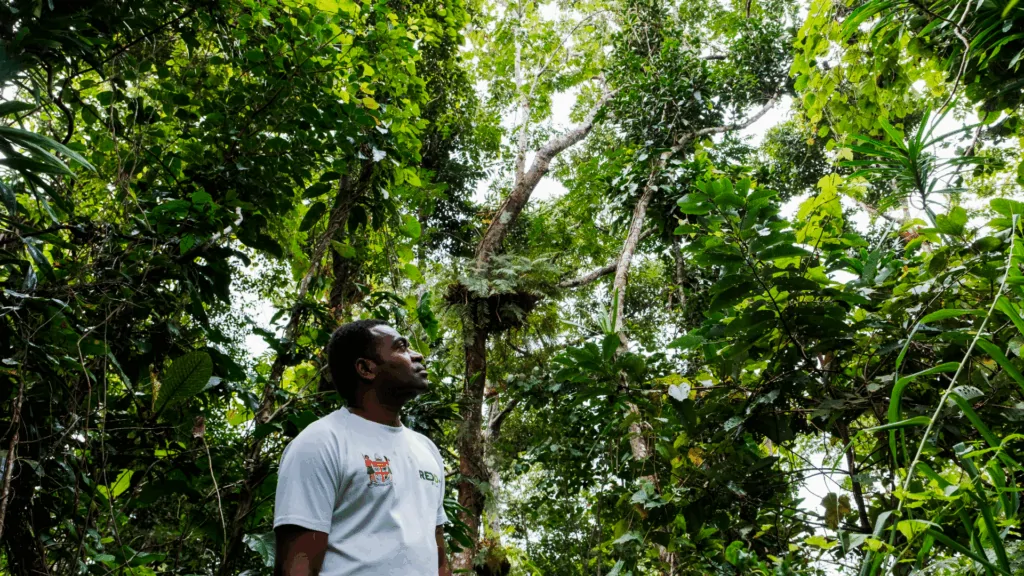
Forest ranger Jerry Lotawa in the Plan Vivo Drawa Nakau project, which conserves forests in Fiji. Photo: Rob Rickman.
There is reason to see rays of hope even at the global level. I believe we will see a breakaway group of countries creating their own climate summit—those who really want to bring about change!
I feel confident and hopeful about 2026. The climate issue is one of the most important for companies and their long-term strategies.
Make climate change your top priority in 2026! Not because you have to, but because you want to make a difference and strengthen your business. Together with us at ZeroMission , you ZeroMission personalized assistance based on your company's specific needs. Contact us today to accelerate your transition plan.