How do smallholders benefit from planting trees?
September 11, 2023
Healthy, diverse forests sequester carbon and help mitigate climate change. We know that. But trees are more than just a carbon sink. Unlike technical solutions for negative emissions, they improve habitats for wildlife, prevent soil erosion, create livelihoods and contribute to important ecosystem services. It is these benefits - beyond carbon - that make the case for nature-based solutions. And who better to talk about these benefits than the smallholders we work with in the projects?
To this end, we recently interviewed four smallholder farmers participating in the CommuniTree Carbon Program in Nicaragua. We asked what benefits this program working on nature-based climate solutions has contributed to improving their land and their livelihoods. What they had to say really reminds us that forests are not only a carbon sink, but that they also contribute to many other positive factors.
Four smallholders explain why they choose to be part of the CommuniTree project.
Cooler temperatures and shade
The ability of trees to store greenhouse gases and help tackle global warming is often discussed on a planetary scale. But trees also cool the air and contribute to lower temperatures on a local scale, partly thanks to the shade provided by their foliage and partly thanks to a process called transpiration. Transpiration is when plants release water vapor from their leaves into the atmosphere.
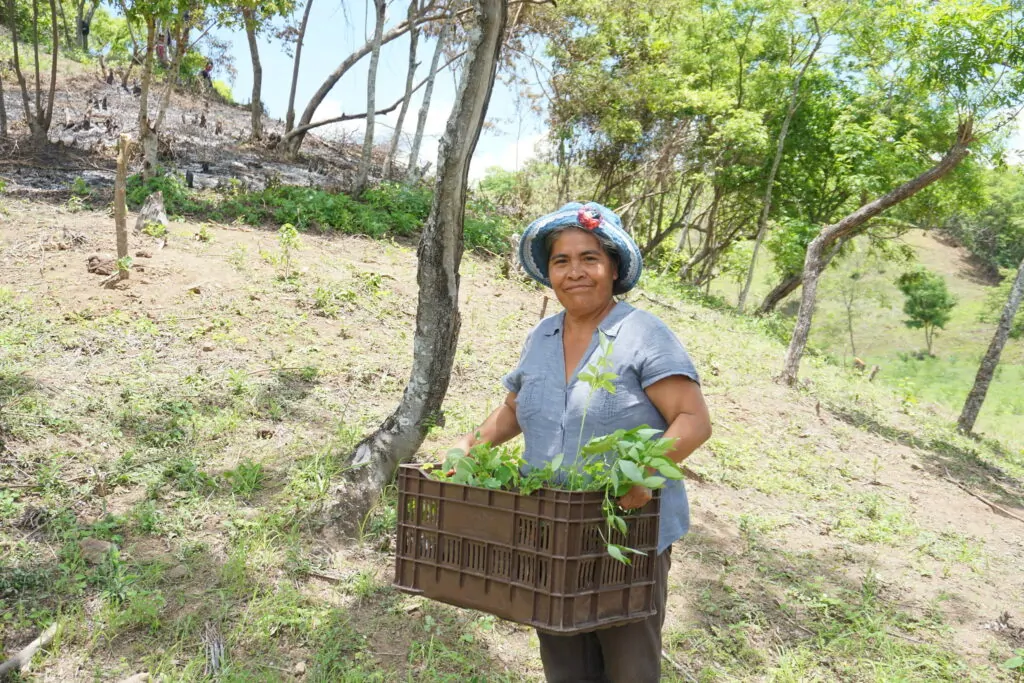
Smallholder Justina Gutierrez Muños, also involved in the project.
Florentina Palma has experienced this cooling effect first hand. She describes how, when she was a child, there was a large forest around her home. That forest was lost and made it unbearably hot. Then she joined CommuniTree and started to experience a clear change in the local climate around her house. Today, the trees she planted in 2012 provide her with shade. "I can feel the change in myself, in my land and in my house, which is now very cool," she says. "The trees help keep the ground and soil moist. My cows stay under the trees and enjoy the coolness."
Replenishment of water resources
Transpiration contributes to the formation of clouds, which in turn creates rain. The trees then catch the rain and prevent the top layer of soil from being washed away during storms. This helps replenish groundwater levels and prevents soil erosion, as Ernesto Cedeño Mendoza can attest. He joined CommuniTree in 2013. Since then, he too has noticed a clear difference both in his water supply and on his land.
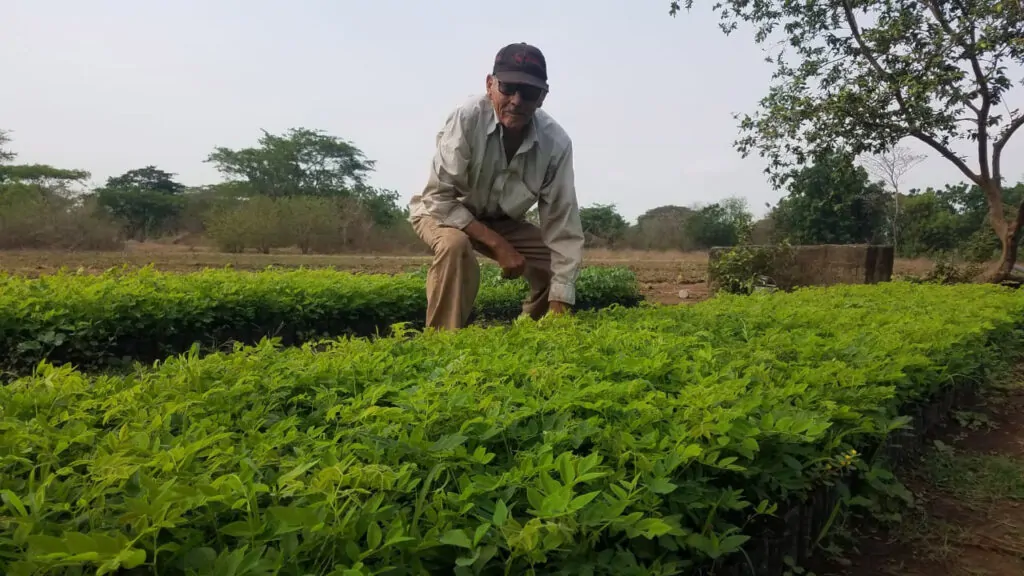
One of the project's many nurseries supplying trees to smallholders.
"I have a well about 30 meters from the house. That well was always dry before. Not only did it dry out the land, but it also meant we couldn't have livestock or anything else." Ernesto explains that planting trees has changed this. "Now there is plenty of water in the well! This is because of the reforestation project and because of the trees." Ernesto has also installed a hose and a hand pump, and he uses the water from the well for his plants, his animals and for other household chores. Ernesto has also noticed an improvement in his land. "Before, the rain washed away the soil. Now it is much better. Before it was deserted here, and now with the trees the land has recovered."
Florencio de Jesus Perez Matutes, a 79-year-old farmer from San Juan de Limay, tells a similar story. During a visit to his farm, Florencio points to a stream. "That one used to dry up during the summer," he says.
Improving biodiversity
However, it is not just about simply planting trees. Monoculture plantations are not preferable because they do not contribute to increased biodiversity and ecosystem services. That's why CommuniTree's system of plantations includes a diversity of species that are all local to the area. Native trees have a better chance of survival because they are adapted to the environment, and they also promote biodiversity by providing food and shelter for local wildlife.
Narciso Valdivia Lanuza realizes this about his own forest. It was planted 11 years ago and, like all CommuniTrees areas, allows natural regeneration. "Now that we've been working on reforestation, we've identified more animals in the area, more birds," he says. "Walking through this forest makes me very proud. It makes me very happy. I want to come here all the time, I notice a big change from how it used to be."
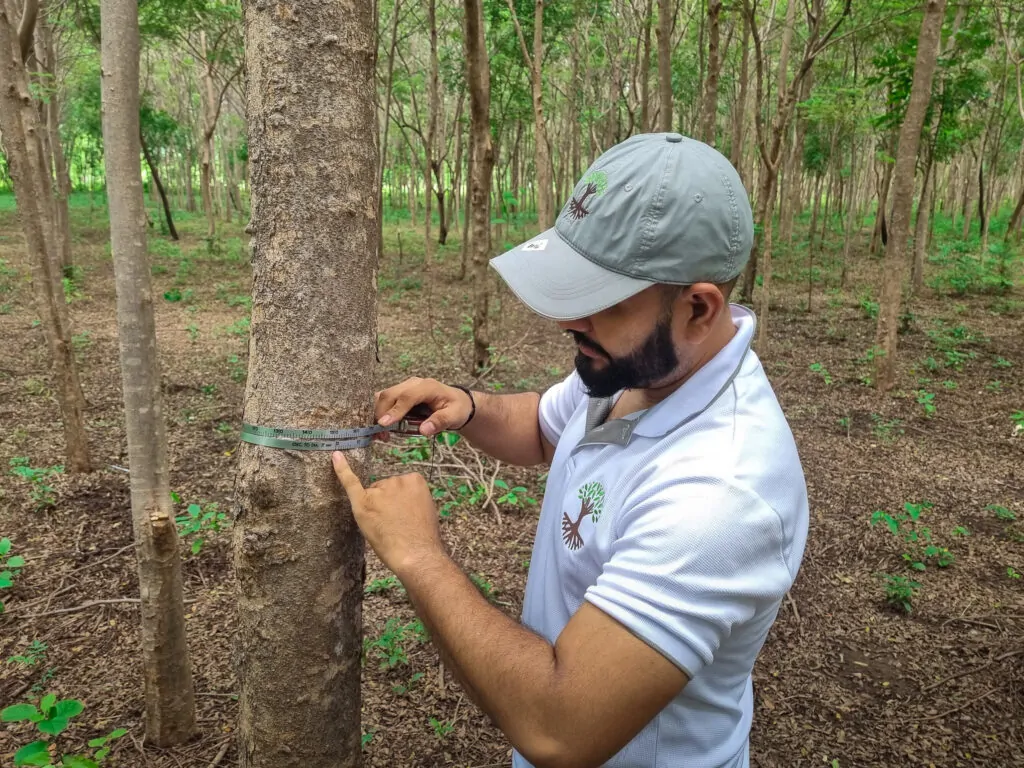
One of the project's techniques measures the growth of trees, which is one of the methods to check how much carbon dioxide the trees are storing.
Having recently thinned his forest, Narciso has also experienced the livelihood benefits associated with sustainable forestry practices. Speaking about the income he has received, he says: "It gives me hope as a farmer who does not have a salary. This project is a way to give us real benefits."
Improved household income
As Narciso suggests, growing trees can provide short- and long-term livelihood benefits to smallholders. Florencio de Jesus Perez Matutes explains that when he joined CommuniTree in 2012, he started receiving payments for ecosystem services. These payments helped him maintain his forest. As his trees grew, he was able to use some of the wood from the trees that had been thinned out as posts for the fence on his farm. His forest also provided timber to build his house. "All this has been an advantage," explains Florencio. "I haven't had to take out my wallet to buy that wood."
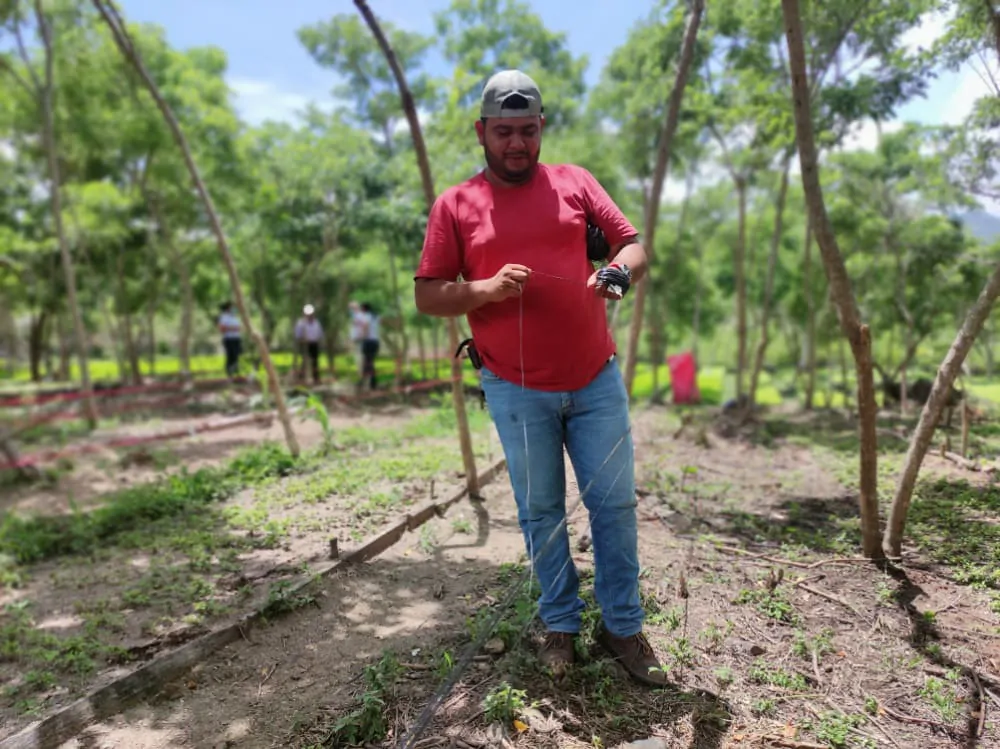
Trees in the process of being planted.
Growing trees has also given Florencio an additional source of income. "Before, I only had income from the beans I grew; I also grew corn and some other small things," he says. "Now, the income from the project is complementary and benefits my family." He explains that his household no longer struggles to buy food as they once did. "The project has had a great impact within the family, because it solved a problem that I could not solve before," he says.
Planting forests for long-lasting benefits
There is also one last benefit to mention: that of legacy. What is special about growing trees is that its tangible benefits are not only experienced now; they will also endure for future generations. As long as the world's ecosystems are restored, biodiversity will recover, groundwater supplies will be replenished and livelihoods will improve. As Florencio says: "I have children, I have grandchildren, and even if I don't benefit, they will."
This is the essence of nature-based climate solutions. It's not just about planting trees with the sole purpose of sequestering carbon. It is about creating real impacts that benefit nature, local smallholders and, ultimately, humanity globally. When forests are restored with care, these impacts will continue over time, to everyone's benefit.
This is a translation of an article written by TakingRoot. Read the original article here.