Carbon emissions from purchased electricity - how to report in your sustainability report
October 2, 2025
Reporting carbon emissions from purchased electricity is an important part of sustainability - but did you know there are two different ways to count? By reporting under both the location-based and market-based method, your company will not only have more transparent climate reporting, but also a clearer picture of how strategic electricity choices can reduce your carbon footprint and drive the transition towards a sustainable energy system.
Greenhouse gases Scope 2 Greenhouse Gas Protocol
When companies calculate their carbon emissions under the Greenhouse Gas Protocol (GHG), emissions from purchased electricity are included in what is known as Scope 2. To increase comparability and transparency, these emissions should be reported using two methods: location-based and market-based.
Location based - location based
The location-based approach is based on the average emissions intensity of the electricity network where the consumption takes place. This means that the calculation reflects the actual composition of the electricity mix for the geographical area, regardless of the electricity supplier chosen by the company. The type of energy used in Sweden is a mix of different energy sources, with a significant part coming from renewable sources such as wind, hydropower and also a small part of solar energy. Fossil energy is also used. In other countries, energy use is different.
Market based - market-based
The market-based approach takes into account the active choices your company makes when purchasing electricity for your facilities or offices. Instead, it takes into account direct contracts with your electricity supplier, as well as different types of energy certificates, such as Guarantees of Origin (GOs) and Renewable Energy Certificates (RECs).

Jimmy Jensen, climate strategist at ZeroMission and expert on sustainability reporting.
If no contracts or certificates are used, what is commonly referred to as the residual mix is instead applied in the calculation of your carbon emissions, which is the part of the electricity in the grid that has not already been allocated through contracts and certificates. In Sweden, the residual mix consists largely of fossil-based electricity, which leads to higher reported emissions than under the site-based method.
When is it appropriate to use which method?
- The location-based approach is suitable for showing absolute changes in your energy use, for example the effect of energy efficiency improvements.
- The market-based approach shows whether your company is actively purchasing low-carbon or renewable electricity, and thus better reflects your climate strategy choices.
Sustainability reporting ESG platform
In our ESG platform Our Impacts platform, Scope 2 emissions are automatically calculated using both the location-based and market-based approaches. By reporting carbon emissions according to both methods, your company will get a clearer picture of how your energy use affects the climate, and how purchasing renewable electricity can contribute to a more sustainable business.
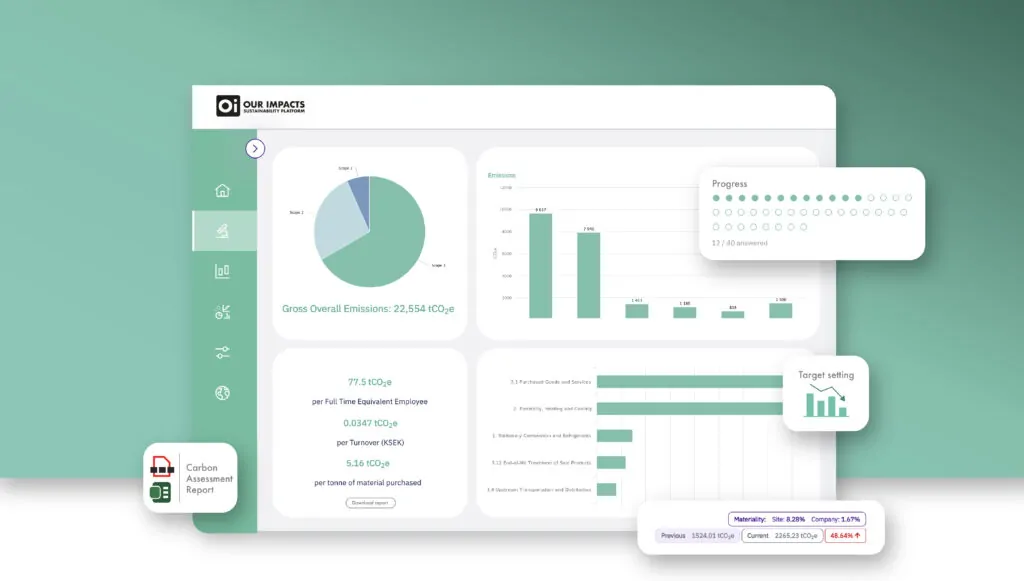
Our Impacts ESG platform for sustainability reporting.
Guarantees of origin for renewable electricity
Do you need to buy origin-labeled electricity? Through ZeroMission , you as a customer can buy certificates of origin directly. By purchasing guarantees of origin from renewable electricity, you reduce your company's carbon footprint, while accelerating the transition to a sustainable electricity system through the expansion of renewable electricity production.
Whether your electricity consumption is in the US, Asia or Europe, we can offer competitively priced Guarantees of Origin that show your electricity is renewable - no matter where in the world your business is located.
Contact us to learn more about how Scope 2 calculations can strengthen your sustainability efforts!