Summer has turned into fall, and my phone is filled with summer memories. Filled with the challenges of my new job at ZeroMission , I set out to take stock of the summer. Of course, I choose to offset the estimated emissions.
On behalf of ZeroMission , the analysis and research company Novus has asked just over 1000 private individuals about climate compensation. The survey shows that those who consider themselves to be actively working to reduce their climate impact also compensate to a greater extent for the emissions that still occur. In other words, those who offset are doing one more thing to reduce their footprint than those who are unaffected by the ongoing climate change.
My family and I like to travel abroad for the holidays. There have been many flights, albeit not very long ones. We've stayed within Europe, but in recent years we've switched from flying to taking the train. Mainly because we want to get more out of the trip, but also to reduce its climate impact. The Wenell family thus belongs to the category that considers itself actively working to reduce climate impact. Now climate compensation is also to be done here, measure-reduce-bind.
The first task is to try to measure the climate impact. How many carbon dioxide equivalents correspond to the total emissions caused by the family during the train trip to Brittany, the mountain hike in Härjedalen and the visits to the family's summer cottages on Gotland and in Roslagen?
For those who want to calculate their carbon footprint, there are several different tools. I think klimatsmartsemester.se is a good tool that clearly guides the traveler. By choosing the mode of transportation and type of accommodation, each part of the trip can be calculated. In Wenell's case, this mainly involves trains and cars, as well as accommodation with a low climate impact. In addition, there are emissions from everything we ate and things we bought. Since we mostly cooked our own food, and ate the same things as at home, I leave the impact of food out of the vacation calculation. In total, it turns out that the family's travel and accommodation during the holiday is responsible for greenhouse gas emissions equivalent to 1.9 tons of carbon dioxide equivalent. This can be compared to the fact that the trip to Brittany alone would have "cost" four tons if we had chosen to fly instead of train and stayed in a hotel instead of an apartment.
The next part is to reduce. Compared to how we vacationed a few years ago, our family's emissions have decreased significantly. This is largely because we have switched from flying to taking the train, but also because we stay more often in rented apartments than in hotels. But of course there is more to do. For example, for next year we can widen the scope and count on the extra ice cream and shopping that the holidays bring.
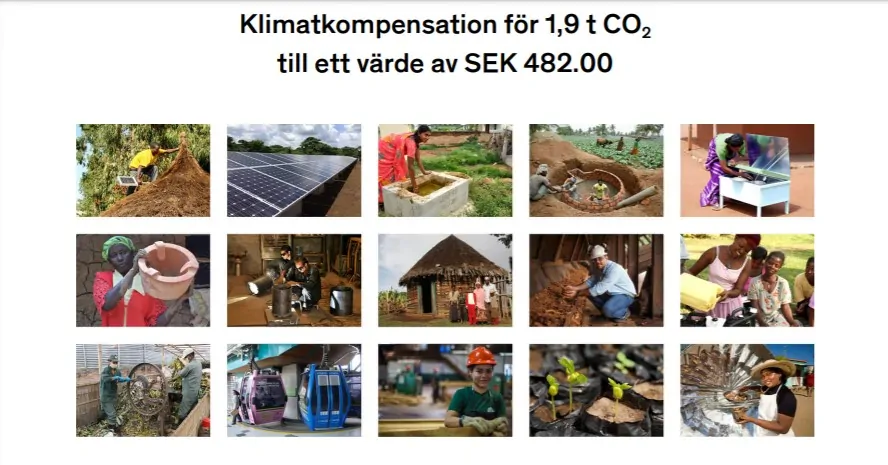
Finally, bonding. Through ZeroMission's carbon offset tool, which anyone can use, I calculate the climate cost of the holiday in Swedish kronor. Money that goes to a carbon offset project in one of the world's developing countries. The invisible has become visible, and the climate cost has been given a line in the holiday calculation. We have not only planned our holidays to reduce our climate impact, we have done a little more. Next year, we will include the climate cost already in the planning stage. It costs to leave your footprint.