Can tree planting balance fossil emissions?
January 11, 2021
Tree planting has sometimes been criticized as a carbon offset mechanism, arguing that climate benefits cannot be guaranteed for longer than a few decades. At the same time, emissions from geologically stored fossil materials have a duration in the atmosphere of millennia. Emissions from fossil sources thus contribute to the greenhouse effect for longer than the natural climate solutions can be guaranteed to act as a carbon sink and thus sequester carbon dioxide.
Natural solutions for negative emissions
It is true that planted trees cannot act as a permanent carbon sink and, given a sufficiently long time perspective, the climate benefit will most likely be reversed. The time perspective is key. An individual tree sequesters carbon dioxide through photosynthesis as it grows over decades based on species and climate zone, trees in the tropics sequester carbon dioxide much faster than trees in the more northern latitudes, for example. The potential is most effective in the tropical and subtropical regions, while tree planting in the northern hemisphere has limited potential and effectiveness due to biophysical interactions and counteracting effects of the albedo effect. When the individual tree is felled and eventually decomposes or is burned, the carbon returns as airborne carbon dioxide molecules.
However, the aim of a tree planting project is not to plant single trees, but to create afforested landscapes on previously deforested or unforested land that benefit the local community and the environment. High-quality tree planting projects aim to ensure that tree planting is done in the best possible way, that the right trees are planted in the right place, and that the trees provide the greatest possible benefit to people and nature. For example, by co-planting with agricultural crops in agroforestry systems or to generate timber as a source of income. The basic principle is that the trees, which are gradually pruned, felled and replanted, provide more benefits to the project participants through the ecosystem services they deliver as carbon sinks than they do when felled. The experience from the tree planting projects that ZeroMission works with is that the trees remain, even though the contracts with the participating smallholders are over.
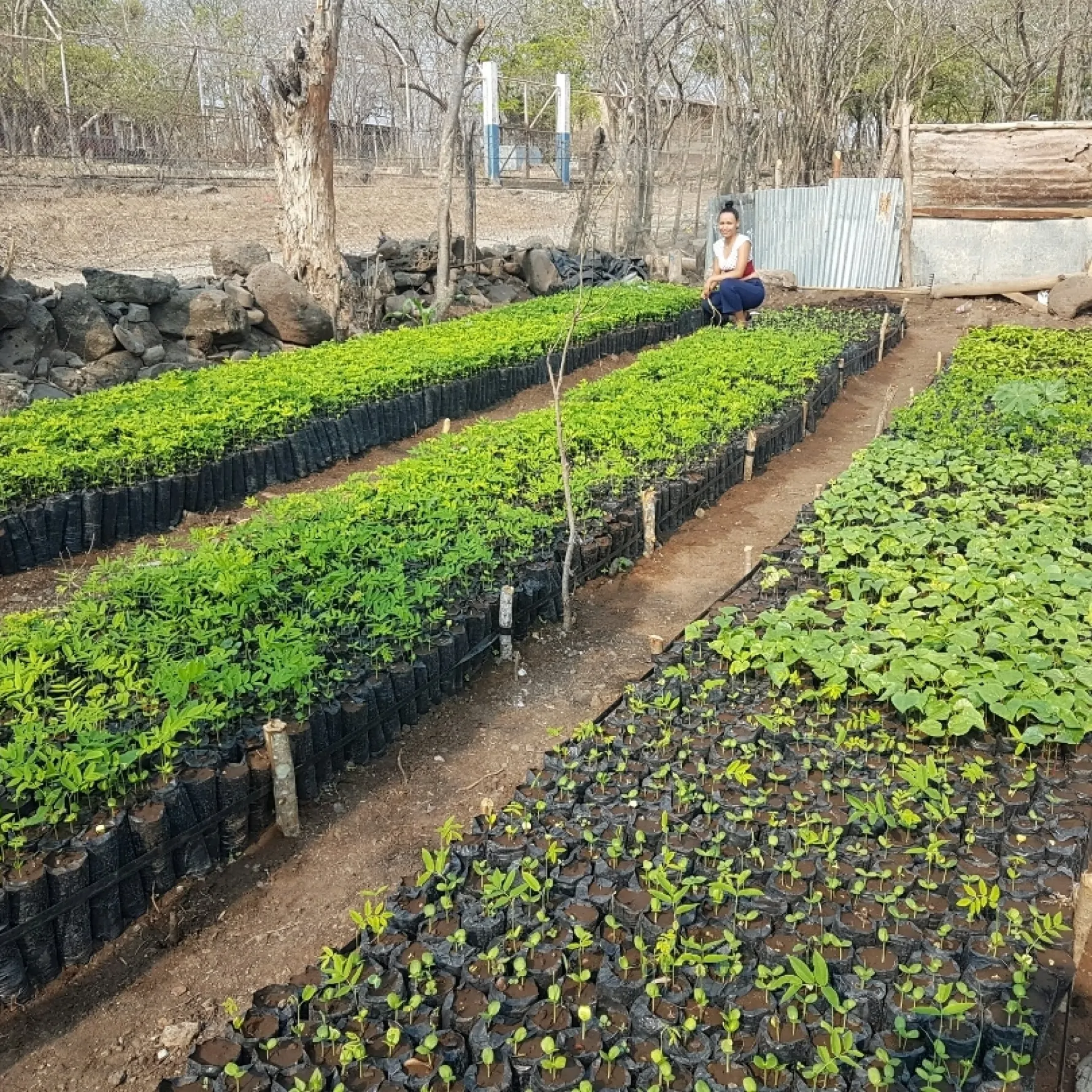
A nursery in the CommuniTree project, Nicaragua.
Can fossil carbon be offset with biogenic removals
But can geologically stored carbon from the long carbon cycle be offset by tree planting from the short carbon cycle? The question lies in the concept of 'offsetting'. The word offset can give the impression of equivalence, that one provides the same or has exactly the same properties as the other. It can further lead to the conclusion that it does not matter whether emissions are reduced or whether they are offset, as the result is the same. According to this interpretation of the concept of climate compensation, the answer is no, tree planting cannot compensate for emissions of fossilized carbon as the carbon sinks are of different types and have different properties. Fossilized carbon will remain in the ground unless humans actively pump it up, while carbon sequestered in forests and soils risks returning to the atmosphere as carbon dioxide in the event of unpredictable events such as forest fires. Once in the atmosphere, carbon dioxide atoms emitted from fossil sources have the same effect as emissions from biogenic sources.
According to the IPCC, natural climate solutions are one of the most effective and robust ways to mitigate climate change while creating and enhancing ecosystem services that benefit both communities and biodiversity (IPCC, Special report on climate change and land, 2019). Natural climate solutions have the potential to deliver over a third of the emission reductions needed to stabilize warming well below 2 degrees in a cost-effective manner (Griscom et al., 2017). Despite this potential, only around 2% of carbon offset is directed towards natural climate solutions.
Negative emissions technologies are not currently scalable or cost-effective for negative emissions to the extent required (EASAC, 2018). In the future, it is possible that these types of projects will be cost-effective, scalable and sequester a significant share of global emissions. But we are not there today.

Smallholders prepare the land for planting carefully selected trees.
Tree planting - not an alternative but a complement to drastic emission reductions
It is true that fossil carbon sinks are different from soil carbon and that the first and foremost priority for a company is to drastically reduce its fossil emissions. But meeting the Paris Agreement climate goals also requires negative emissions, and preserving the natural forest we have left and planting trees on previously deforested land is one of the most effective ways to do so. This is where carbon offsetting comes in as an important tool that companies can apply in their climate strategy. Measuring and significantly reducing emissions from the entire value chain and at the same time financing natural climate solutions is an operationalization of what the Paris Agreement and the IPCC require us to do on a global level. Tree planting and other natural climate solutions will never be a solution or alternative to emission reductions. But it remains an important tool available today to take responsibility for climate impacts and at the same time contribute to added value for communities that today are most affected by the consequences of climate change.
References
EASAC (The European Academies' Science Advisory Council) (2018). Negative emission technologies: What role in meeting Paris Agreement targets
IPCC (Intergovernmental Panel on Climate Change) (2019). Special report on climate change and land, summary for policy makers.
Griscom, B. W., Adams, J., Ellis, P. W., Houghton, R. A., Lomax, G., Miteva, D. A., ... & Fargione, J. (2017). Proceedings of the National Academy of Sciences, 114(44), 11645-11650.