Law and order - should we go back to basics?
November 16, 2019
Dagens Nyheter's ongoing investigation into airlines and how the climate impact of air travel is calculated has had a ripple effect. Carbon offsetting is neither simple nor black and white, but it seems we need to go back to basics.
Do you recognize this from your teachers at school?
- "Good! But can you show how you solved the task?"
- "Print each line of the calculation? Show me what you were thinking."

Blackboard: Time to show how the calculation was done!
Airlines audited - the importance of transparency & traceability
Part one of the review has highlighted problems with the transparency of airlines and their suppliers. The key message from journalists is that there is no possibility to trace and follow up on the statements and claims made by airlines.
Transparency is crucial when trading certificates from projects that are often far away, and when trading something as abstract as sequestered, avoided or conserved emissions. It is fundamental to the credibility of the industry, and something that we at ZeroMission take very seriously. The Markit registry is key to this, where the carbon offsets from the majority of our projects can be tracked, and where the credits our customers buy are canceled (i.e. permanently locked on their behalf).
A unique feature of Plan Vivo certified projects is that they report annually on their activities, successes, challenges and finances, in the annual report that all projects are required to produce. This transparency is essential to understand and track the benefits they achieve. It also makes it possible to continuously assess additionality, which is an important metric in carbon offsetting.
Order and order, politics is reacting!
The reactions to DN's blog series also come from politics. Minister of Infrastructure Tomas Eneroth (S) announces that the government has decided on reporting requirements for all travel companies that sell longer trips, to make the figures between the companies comparable and scientifically based.
Here too, transparency is in demand. How have the companies calculated their emissions? Of the reviewed aviation calculators listed by DN in part 2, there is a wide spread in the results. For us, it is a matter of course to follow the latest science and new findings, and it was nice to have it confirmed that our underlying studies are consistent with the values quoted from the researcher Jonas Åkerman at KTH. It is fundamental to report how calculations are carried out, and especially important when there are such large variations in methodology that lead to differences of "over 400 percent - for the same trip."
We present our methodology clearly in the documentation next to the calculator, here.
That's what all conscious consumers should be looking for.
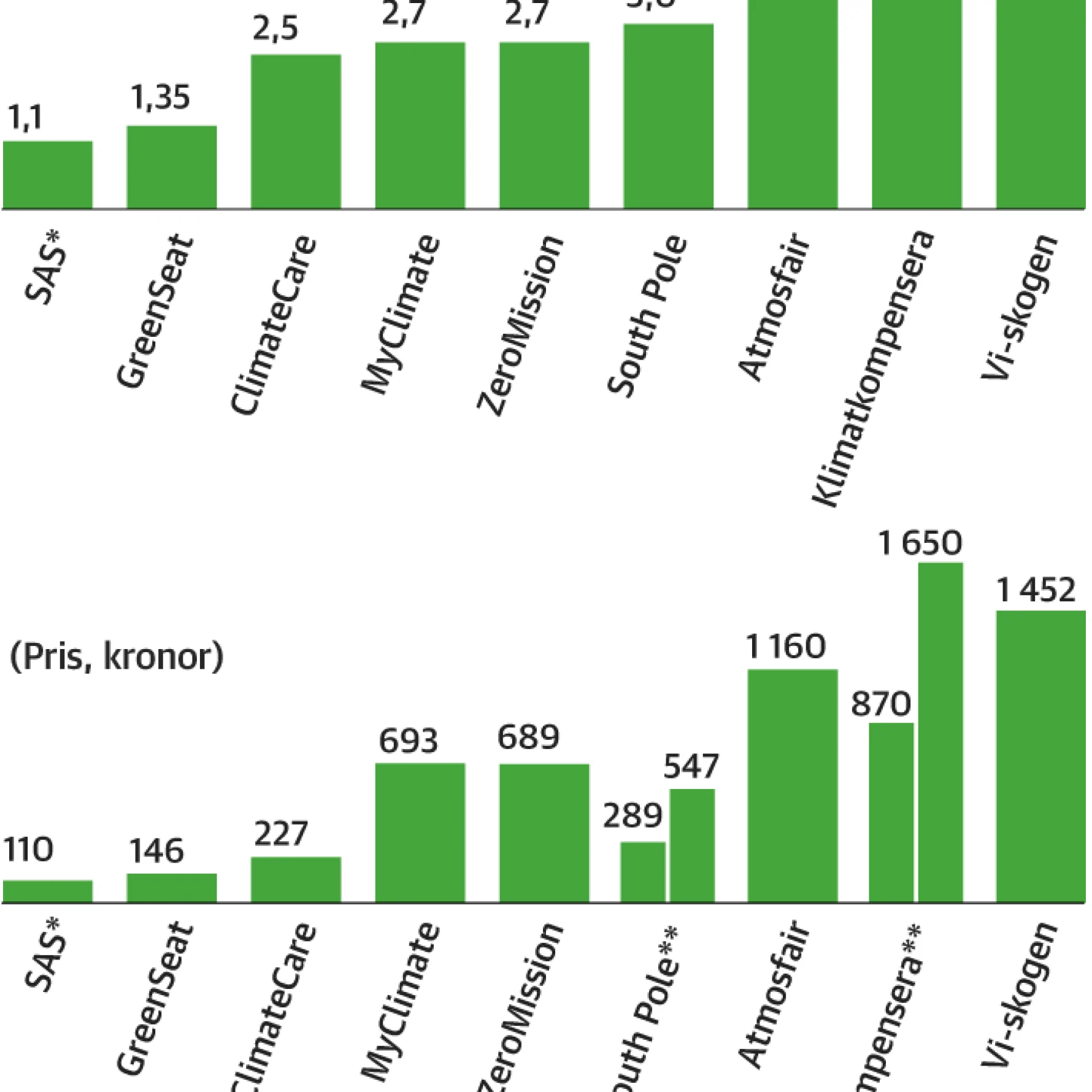
Exciting to see how the calculations can vary so much! Image: graphic from DN's article on flight calculators on October 14, 2019.
The questions you need to get used to asking!
Carbon offsetting is a tool to put a price on emissions, and a tool that can finance climate adaptation and sequester carbon in a way that allows us to meet the 1.5 degree target. As the climate rapidly changes, it is increasingly likely that more people will seek offsetting as a direct action in the near future.
For the consumer, this poses a challenge. Whether we are acting as individuals or in our professional roles, it becomes important to understand what we are buying. It will be important to stick to what we know and go back to the basics we learned in school:
- Give an account: How did you think when you solved the task?
- How is this calculated, show me.
- Where is my money going, can you show me what I am paying for?
- Who does what, and when, when I offset?
- Is there any evidence or sources?
Sources and references:
https://www.dn.se/nyheter/sverige/sas-berakningar-ger-fyra-ganger-mindre-utslapp-an-konkurrenters/
https://www.dn.se/nyheter/ministern-bolagen-maste-skarpa-sig/
https://www.dn.se/nyheter/sverige/klimatkompenserade-resor-omojliga-att-kontrollera/
https://mer.markit.com/br-reg/public/index.jsp?s=ca
Image 1 and 2: taken from Pixabay.com